
Entrée chez soi Brome-Missisquoi has 11 apartments (unfurnished) in Farnham and 13 apartments in Cowansville.
In total, there are twenty 3 1/2 dwellings (for couples or single people) and four 4 1/2 dwellings (the number of occupants permitted is defined by the Housing Office according to the age and gender of the children, if applicable).
A worker is present two half-days per week to offer community support.
These dwellings are subsidized by the Brome-Missisquoi Housing Office and the cost of rent is 25% of the tenant's income (plus costs for electricity, parking and access to the laundry room).
The buildings operate like a housing cooperative.
Tenant members must agree to:
Please note that tenant members can request mental health follow-up with a counselor from the organization, just as external individuals can. They are not required to do so, and the organization is also not required to provide individual follow-up.
Selection interviews take place every two months. During this interview, the person will be assessed to determine if there is a match between the living environment and the person's needs. The three criteria assessed are: autonomy, level of vulnerability (need), and level of commitment.
A score is then given to the person (the average of the scores given by the 4 members of the committee plus a score for income according to the SHQ scale).
The person may be accompanied, with the approval of the selection committee, only if it is of the opinion that this will not interfere with the selection process. The person accompanying the person must remain silent, not answer on behalf of the person and not intervene during the interview.
The person must complete the SHQ housing application form and the Home Entry form.
They can be sent to us by mail (525, St-Édouard street #101, Farnham, Québec J2N 1G6) or by email (info@entreechezsoi.org)
Please include a copy of the following documents:
– Latest notice of assessment from the provincial government
– The current lease
– Latest electricity bill
Depending on the score obtained during the interview, the person is placed on the waiting list.
Ranks may change every two months following interviews and the person is informed by mail or email.They must notify the organization of any change in contact information and send their notice of assessment each year to remain on the list.
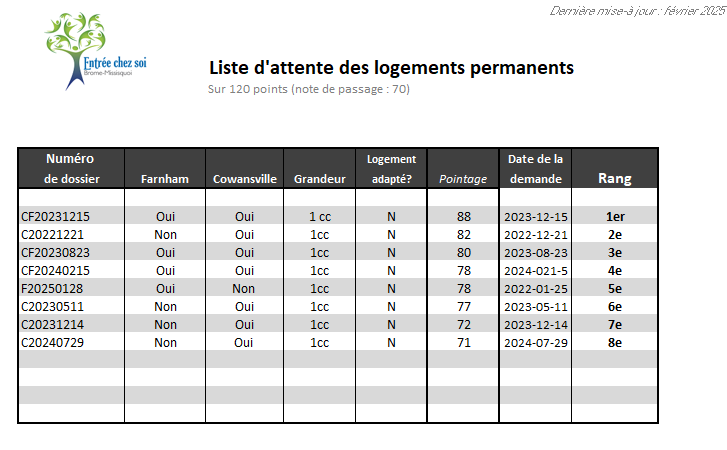
It's impossible to predict how long the wait will be. Some people have waited only a few months for housing. Others have been on the waiting list for years.
When a place becomes available, the person at the top of the waiting list is contacted. They have 7 days to accept the place, otherwise it will be offered to the next person, and so on.
Families have priority over 4.5 and people with physical disabilities have priority over adapted housing.
People in transitional housing must follow the same process if they wish to obtain permanent housing after their stay. Their applications are not given priority.However, they may have a second interview if the work team believes that their progress may affect their score.
Pour plus d’information, vous pouvez contacter Caroline Dolce, directrice adjointe au 450 272-6882 ou à caroline.dolce@entreechezsoi.org
A place that allows you to regain a certain stability in terms of mental health during a more difficult period, to break isolation and learn housing skills. In short, a place that can facilitate recovery and aims for a return to the community. (See the section - Objectives for more details)
It is possible to live in transitional housing from a few months to a maximum of 2 years. The length of stay will be linked to the person's progress, commitment, journey and objectives.
Use the strengths-based approach to support the individual in their individual recovery process.
Accompany the individual to participate in the associative life of the organization by participating in coffee meetings, tenant meetings, activities, etc.
Encourage the individual to learn basic skills and developing functional autonomy.
Support the individual in organizing their life (relocation, access to health services, other community organizations, etc.).
Facilitate the return to the community or to permanent housing through progressive actions.
Initially, the person who wishes to apply for transitional housing must complete the following documents:
– Letter of introduction for form
– Application for housing from the Brome Missisquoi Housing Office
You can find the documents you need to print in the Resources section of our website.
Subsequently, the person must contact the clinical coordinator for a brief explanation of the living code, see if they are eligible and make an appointment for the selection interview when accommodation is available.
The selection interview is conducted in the presence of two Entree chez soi employees. A brief questionnaire is completed with the individual to better understand their needs and determine if they are eligible for transitional housing.
Between the time of the interview and the move-in, a minimum period of 3 weeks is to be expected. (For the submission of paperwork, calculation of the cost of rent by the OHBM, the meeting to sign the lease, etc.)
When transitional housing becomes available, a newsletter is sent to all those registered to notify you. Click here to subscribe.
Pour plus d’information, vous pouvez contacter Béatrice Bénard, responsable du volet, au 450 272-3608 ou par courriel au beatrice.benard@entreechezsoi.org
Community support is a set of actions, which can range from reception to referral, including support with public services, support in managing conflicts between tenants, intervention in crisis situations, psychosocial intervention and support for the tenants' committee, as well as other committees of the community organization.
It is distinct from the services under the responsibility of the health and social services network, but it complements them. It represents significant added value for individuals and families since their condition, life experience or state of health often means that they experience real difficulties in accessing and maintaining housing.
The community support approach aims to collectively support discriminated individuals to enable them to remain in the living environment of their choice, maintain or improve their abilities, or prevent a deterioration of their situation. It represents a means of acquiring residential stability, preserving and developing their individual and collective autonomy, and enabling the inclusion of individuals in the community.
It provides collective support, one-off but continuous over time, housing stability, it is aimed at everyone, in a more global approach to promote living together, good neighborliness and support for initiatives.
At Entrée chez soi, this takes shape in our coffee meetings and the discussion groups that result from them. In addition, for tenants, it represents support in their initiatives (such as film screenings, group outings, community activities, participation in community life, etc.). It also aims to provide assistance, monitoring, and support in maintaining their housing, as well as personal or collective monitoring for other areas of their lives.
Mardi: 9h30 à 11h30 / Jeudi: 13h30 à 15h30
Mardi: 13h30 à 15h30 / Jeudi: 9h30 à 11h30
Entrée chez soi is an alternative mental health resource. We offer individual follow-up in the community. This includes all aspects of the individual's life, based on the organization's values. Follow-ups are of a light intensity (every 3 to 4 weeks) and/or for a temporary need.
We deviate from traditional approaches to adapt to the needs and pace of the person we care for, while remaining professional. A mental health diagnosis is not required to receive support.
Specialized educator
Mental health nurse
Social work technician
Psychosocial worker
Delinquency worker
Our role is to provide help, support, referrals and guidance to people.
Encourage equal relationships between people.
Develop a sense of belonging.
Support the person to maintain or regain balance in their various spheres of life.
Veterans receive mental health services specific to their reality
We provide help, support, referrals and guidance to individuals.
Presentation and implementation of tools
For example, to managing emotions, social isolation and symptoms of depression, anxiety, post-traumatic stress, etc.
Support for transition, civilian life and management of responsibilities
Make information about mental health services more accessible and understandable to the veteran population. Support can also be offered to loved ones affected by the veteran's suffering.
Pour plus d’information, vous pouvez contacter Béatrice Bénard, responsable du volet, au 450 272-3608 ou par courriel au beatrice.benard@entreechezsoi.org
The goal of this training is to equip volunteers, employees of organizations and businesses when they receive people with behaviors that relate to mental health.
2h30 – Training time (allow 3 hours to allow time for discussion)
3h – Content preparation
3h – Adapting the training to each environment
The total cost of the training is $800, for a group of 15 participants maximum.
The training is provided by two instructors trained in special education and social work.
For more information, you can contact the organization
at 450 293-1631 ou par courriel au info@entrechezsoi.org
Workshop to equip you and deepen your knowledge of what happens in your brain when your mental hamster takes control.
For more information, you can contact the organization
at 450 293-1631 ou par courriel au info@entrechezsoi.org
Entrée chez soi Brome-Missisquoi was originally named "La visée : un nouveau départ". The goal was to offer a fresh start to individuals facing mental health challenges and housing instability. Twenty-five years later, we are reviving both the name and the concept as a means of preventing mental health deterioration.
An apartment where up to four people—who are currently experiencing homelessness or are at risk of it—can stay for up to three months to get back on their feet. A support worker is on-site in the evenings to assist residents with practical steps (such as accessing social assistance, finding housing or employment, connecting with organizations, and obtaining medical care) as well as with communal living (fostering social skills, learning to cook, maintaining personal hygiene and a healthy lifestyle, learning housekeeping, and managing daily living and household tasks).
Open daily from 6:00 p.m. to 7:30 a.m., from October 5 to April 30, for people experiencing homelessness or at risk of homelessness. It is a place to warm up, rest, and receive assistance.
Pour plus d’information, vous pouvez contacter Priscilla Leblanc, responsable du volet, au 450 272-6824 or by email at priscilla.leblanc@entreechezsoi.org